Are the "earliest modern human" skulls really modern?
The redating of the Omo Kibish fossil remains prompts a close look at what it means to be a modern human.

The news stories (nature.com) are focusing on the idea that the “earliest” modern humans are now 35,000 years earlier than they had been. This is the amount by which the Omo Kibish specimens are now believed (McDougall et al. 2005) to be older than the previous contenders for “earliest modern humans,” the 160,000 year-old Herto hominids (White et al. 2003). A bit of a discussion has been underway on the Palanth forum as to whether the 195,000 year estimate is really warranted, or whether there is more properly considered a broader range of error.
It is important to have good stratigraphic placement and dates for the Omo Kibish specimens. Most of the Middle Pleistocene African fossils are associated only with poor dates or imperfectly known proveniences. Aside from the recent Herto sample, the dates for other important specimens are truly uncertain. So the knowledge that these hominids are broadly contemporaneous with Herto is immensely valuable.
Are the Omo Kibish hominids "modern humans"?
This depends on one’s definition of “modern humans.” Many paleoanthropologists do not accept a distinction that sharply separates “modern” humans from “archaic” humans. For these scientists, the Omo Kibish specimens may simply be considered as representatives of their time and place, part of an evolutionary series leading to recent humans.
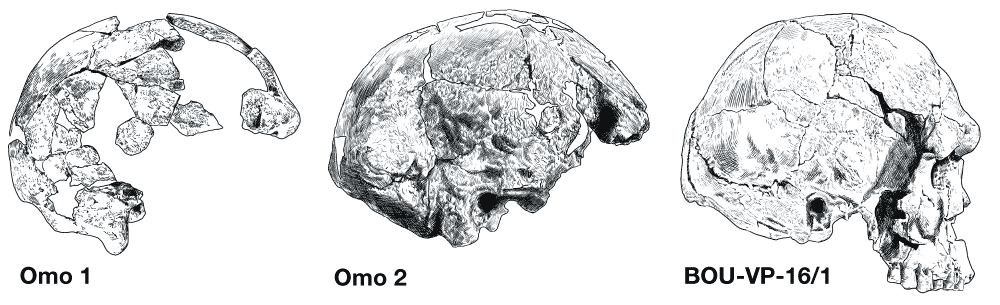
There is no question that features of recent aspect occur within the late Middle Pleistocene African sample. Especially Omo 1 has similarities in overall cranial shape with more recent people. Such similarities also may characterize its facial form, although these details are subject to the reconstruction. Taking the Omo skulls as a sample, together with the Herto sample, the full range of anatomy spans from relatively modern to substantially archaic. Here are some pocket descriptions (leaving out the child’s skull BOU-VP-16/5):
- Omo 1: The occiput is rounded in profile, with only slight flattening of the parietals above lambda. In posterior view, the outline of the skull shows a maximum breadth relatively high on the parietal bones, narrowing significantly lower on the temporals toward the cranial base. The supraorbital torus is not greatly thickened even at the midline, and it thins toward the edges in a form that is continuous with the frontal squama. The interorbital space is relatively narrow. And as reconstructed, the skull appears to have both malar notches and a chin.
- Omo 2: Here, the skull is markedly more angled in the occiput than in Omo 1. The maximum breadth of the skull is at the base, across the temporals, and the sides of the skull are more or less vertical. There is a well-marked angulation of the parietal bones, meeting in a rounded keel. There is a slight angular torus on the parietal, and a well-marked nuchal torus transversely extensive across the occiput. But the frontal bone is continuous into the supraorbital region with no sulcus separating them, and the supraorbital torus itself is relatively thin laterally--perhaps as much or more so than Omo 1.
- BOU-VP-16/1 (Herto): The skull has a distinct angulation in the occiput, as great as Omo 2, with a very long nuchal plane. The skull appears to be slightly broader across the parietals than at the base, but the sides are essentially vertical: there is no distinct parietal boss. The nuchal torus is marked across the occiput, with a distinct downward-projecting inion. The browridge is moderately thick centrally, with a strong superciliary portion, and a clear sulcus dividing it from the curving frontal profile. There is a clear division between this superciliary arch and the lateral torus, which at its lateralmost extent is in the same range of thickness as the Omo 2 lateral torus. The zygomatic bone is very large, with a massive forward-facing cheek, hollowed into a canine fossa medially and malar notch inferiorly.
Several commentators have raised the issue of whether this sample contains multiple species (one going so far as to posit that the “species” immediately ancestral to our own might be preserved alongside the “modern humans” in the personage of Omo 2). A lateral comparison of the three skulls (where their comparable parts are most visible) shows that the differences are not that extensive. The Herto skull and Omo 2 are very similar in profile, with BOU-VP-16/1 being slightly higher in the forehead. Omo 1 contrasts with these in its rounded occiput, but the frontal profile of all three specimens are similar, as are their lateral torus thicknesses. Omo 1 and 2 diverge greatly in the position of their greatest cranial breadth and shape of their cranial walls; BOU-VP-16/1 is intermediate between them. All three are robust, with Omo 1 the least robust of the three. Presumably, all three are males. Their variation is extensive, but not surprising for three crania in a single region of the world.
Are they modern humans? As White and colleagues (2003) show, the Herto skull is outside the range of all recent humans in several cranial measurements. This is no doubt true for Omo 2 as well (although possibly not for the more fragmented Omo 1). But these are not recent, they are ancient. As a sample, they are certainly significantly different from any living sample. They are also certainly significantly different from Neandertals, and from earlier Africans.
So do we define “modern” humans in contrast with some earlier group? Or do we define them based on the variability within living people?
The answer here really is in the word, definition. If modern humans were really an evolutionary individual then we shouldn’t have to define them. We should be able to discover the boundaries of the group by examining discontinuities among fossil specimens. The fact that we have to find a definition (and that we have such trouble doing so) is in my mind sufficient to suggest that “modern” humans are not an evolutionary individual.
References:
McDougall I, Brown FH, Fleagle JG. 2005. Stratigraphic placement and age of modern humans from Kibish, Ethiopia. Nature 433:733736. doi:10.1038/nature03258
White TD, Asfaw B, DeGusta D, Gilbert H, Richards GD, Suwa G, Howell FC. 2003. Pleistocene Homo sapiens from Middle Awash, Ethiopia. Nature 425:742747. doi:10.1038/nature01669

John Hawks Newsletter
Join the newsletter to receive the latest updates in your inbox.